
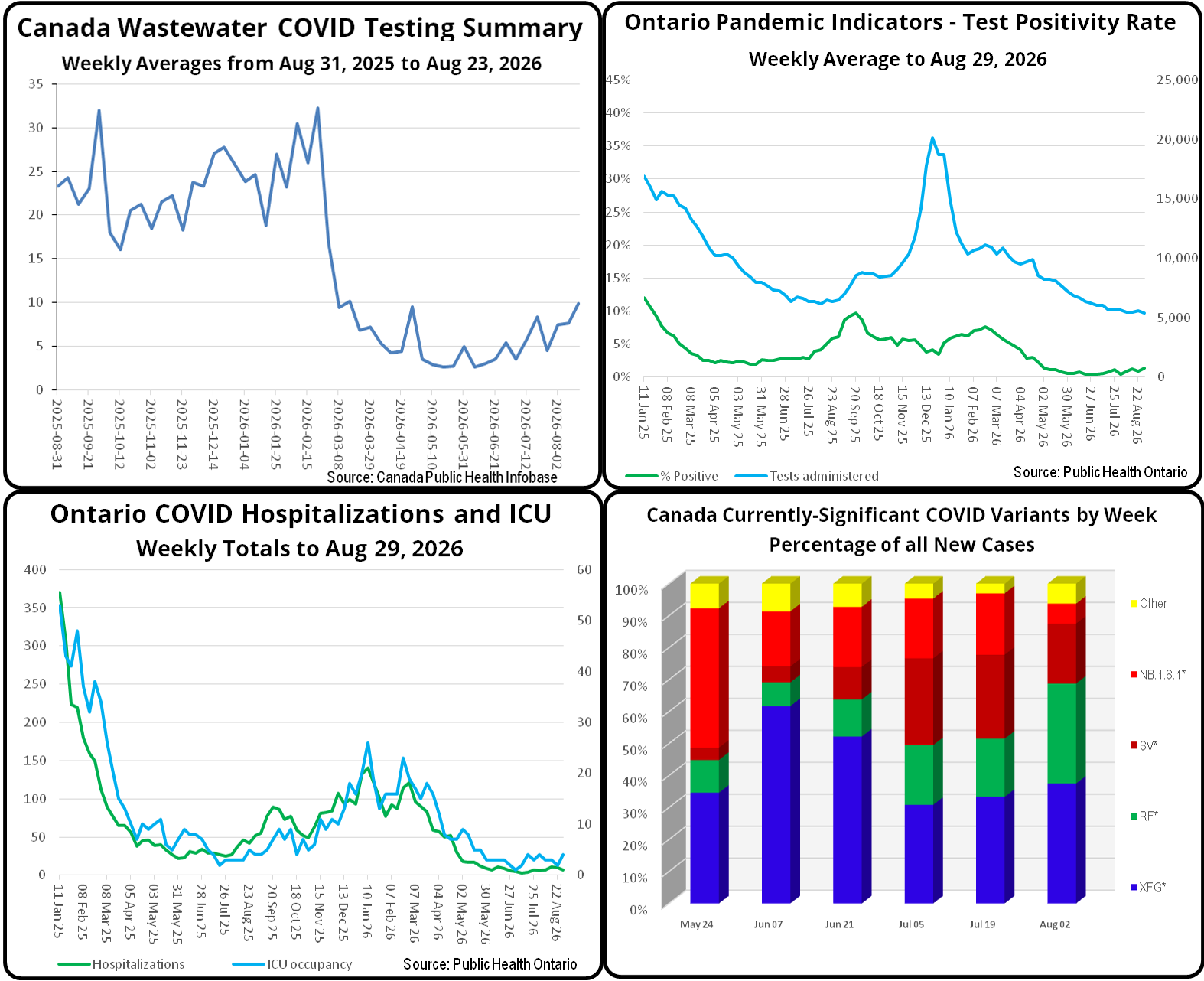
The Canadian COVID infection data released over the past week confirms that the seasonal low in new cases has definitely passed, bringing us into the next cycle.
Turning to our weekly composite chart, that trend is especially visible in the Canada-wide municipal wastewater COVID PCR testing curve which shows a definitive national rise in circulating COVID virus counts back up to levels last seen in early May. Those counts provide a leading indicator of new infections. Next comes the PCR tests positivity rate which, while still low in Ontario at 1.4%, is likewise the highest since early May. Ontario COVID hospitalizations and ICU bed occupancy rates usually lag positivity rates by a couple of weeks. Those rates thus far remain low but can be expected to rise, especially once the results of much-increased back-to-school-and-work exposures become reflected in the statistics. The good news is that all those numbers remain far lower than in previous years.
The more independent health statisticians at COVID-19 Resources Canada have yet to provide their now-monthly update, which will hopefully be available next week. I’m anxious to see their estimate of the number of infected and therefore infectious Ontarians.
Public Health Canada’s latest biweekly report on currently-circulating COVID variants paints a thus-far-unusual picture of a rough balance in the “market shares” of the currently circulating families of Omicron variants. The previously-dominant XFG family, accounts for 37.5% of all new Canadian infections and is in a dead heat with the still-diversifying NB.1.8.1 family of Omicron strains which had been dominant for much of last year. But both are on the verge of being overtaken by the new and more rapidly spreading “RF” recombinant strain, which has already reached 31%. Fortunately, there is still no evidence of the RF strain producing more severe symptoms than the existing strains which it is replacing.