
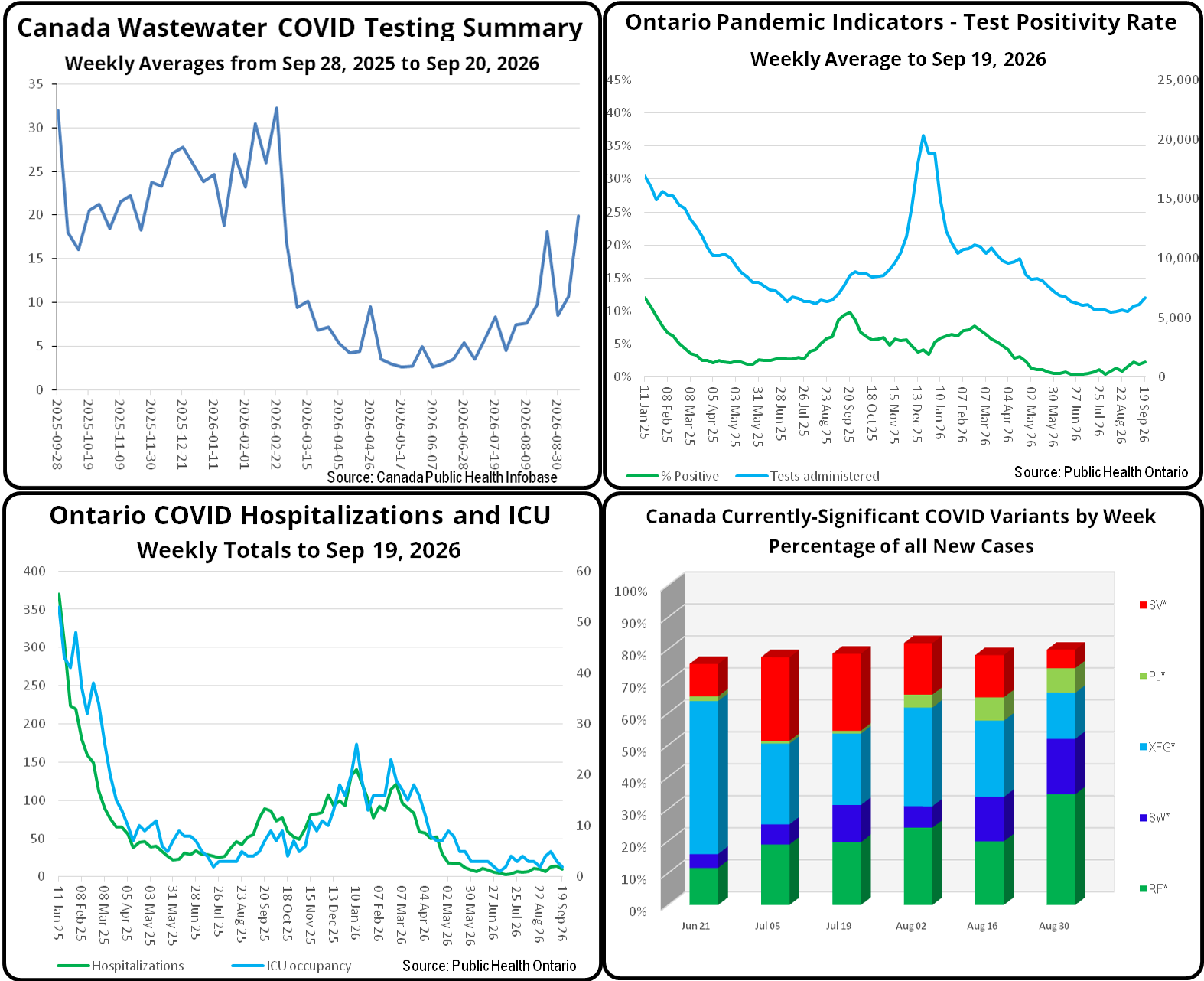
This is my first update since that of September 12, the gap having been due to my being away on an extended Eastern Canada road trip. There were no big surprises during that period, the rate of new COVID infections having risen significantly following the end of the pandemic’s seasonal lows, but less strongly than in previous years.
During that period, the Canada-wide municipal wastewater COVID viral counts climbed faster than expected from their historic summer lows, approaching those of last year at this time.
At 2.3% as of mid-September, the positivity rate from Ontario PCR COVID testing were already triple their summer lows, albeit still only a third of what they had been last year at the same time. COVID hospitalizations and ICU bed occupancy, always a lagging indicator, remain well below their equivalents from last year.
The statisticians at the more independent COVID-19 Resources Canada now estimate that one in 189 Ontarians are currently infected and hence infections. That’s a significant jump from their previous estimate of one in 280.
Public Health Canada’s update on currently-circulating COVID variants showed significant shifts compared to my last report. The relatively new RF.5 Omicron variant now accounts for 36% of all new Canadian COVID infections, giving it the largest single “market share”. It is the latest strain in the existing B.1.1.529 family, which also includes the currently-circulating PJ.2.1 strain and others of the previously-circulating JN.1 line. Thus far, none have shown any signs of causing more severe symptoms than others which have been circulating this past year.