
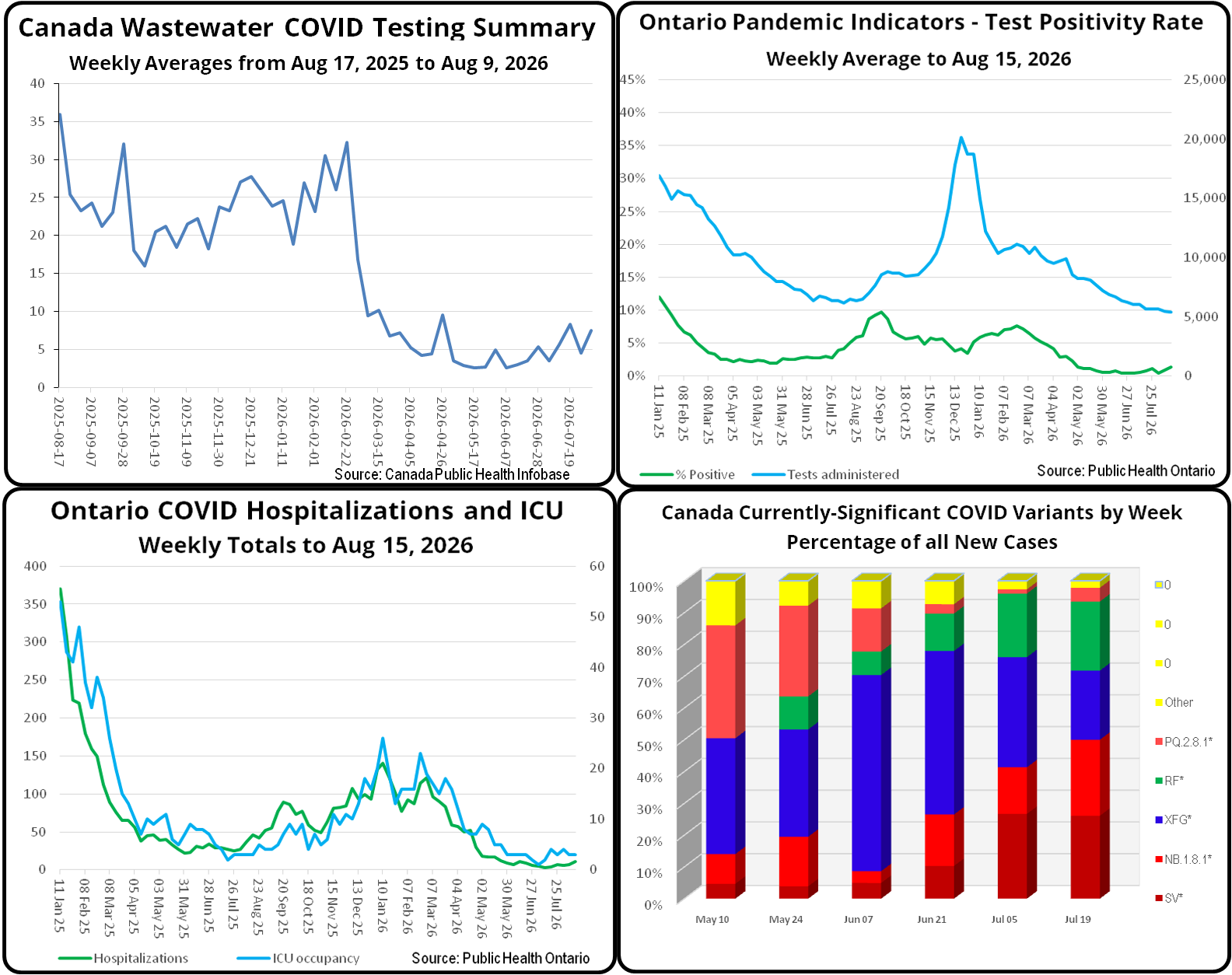
Once again over the past week, there has been a modest increase in COVID activity, which is consistent with the seasonal low in new infections having passed.
The Canada-wide municipal wastewater COVID testing curve continues to rise very slightly from its historically lowest point since the beginning of the pandemic. Likewise Ontario PCR COVID testing results, with a still-low 1.4% positivity rate being the highest since last May. Ontario COVID hospitalizations also remain historically low, but are now the highest since mid-June and climbing.
The more independent health statisticians at COVID-19 Resources Canada have yet to update their last report of several weeks ago, which estimated one in every 280 Ontarians being currently infected and therefore infectious.
What’s more interesting is Public Health Canada’s latest biweekly report on currently-circulating COVID variants. It shows the emergence of a new family of Omicron variants, labelled “RF”. It is another recombinant variant, which emerge when two different Omicron strains infect the same host cell simultaneously and exchange genetic material. That mechanism can result in more varied changes in symptoms and infectiousness (i.e., the ability to more successfully evade immunity from prior infections or older vaccine formulations than the much more frequent point mutations). RF’s rapid rise in “market share” and very similar symptoms to those of previously-circulating strains suggest that it is not intrinsically more dangerous than its predecessors, but it bears watching given that its rapid spread demonstrates increased infectiousness. The older NB.1.8.1 Omicron family remains dominant, accounting for 57% of all new Canadian infections, but RF is already tied with the XFG family for second place.