
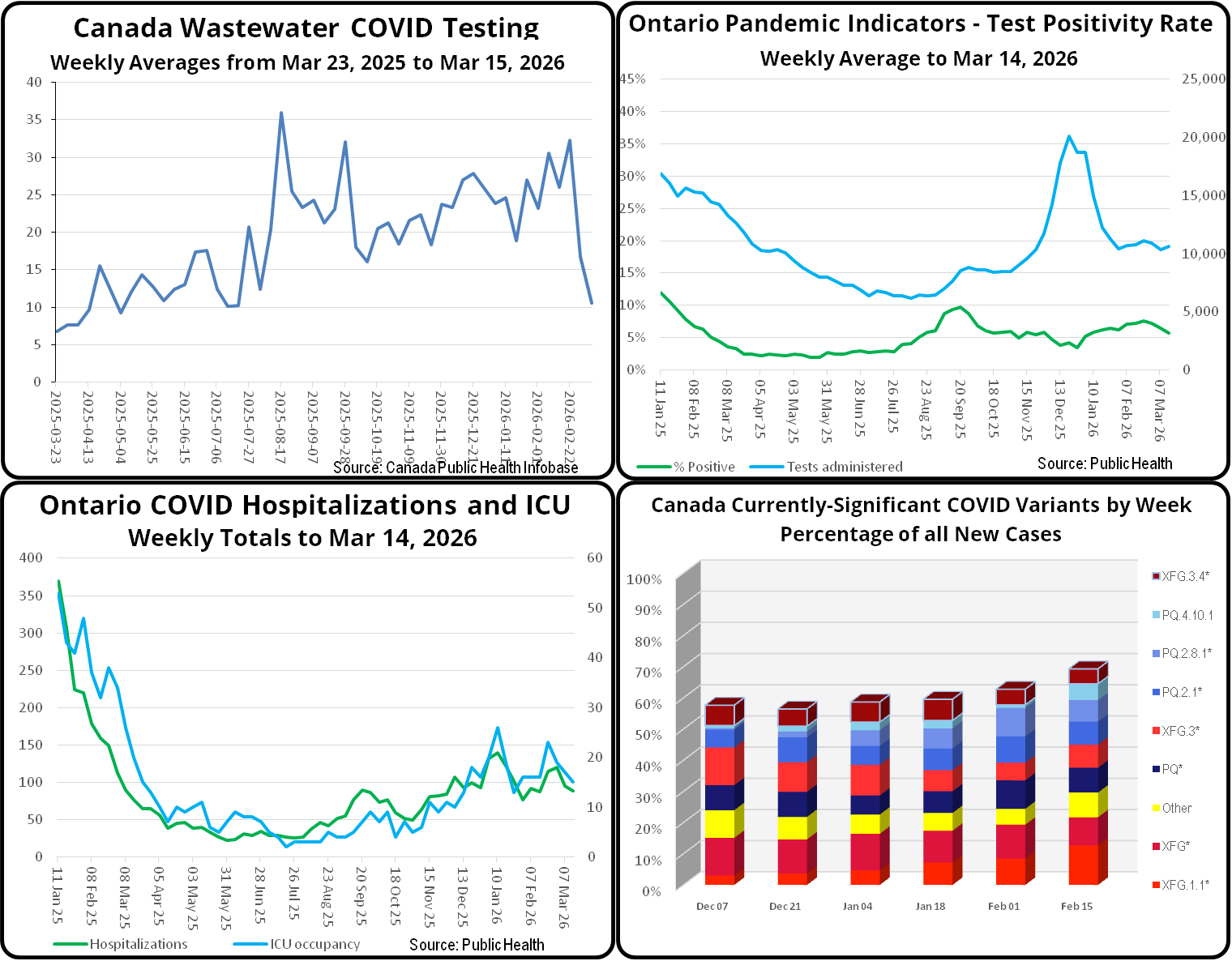
The most recent published official data on COVID infections showed a continuation of the trend that, in Ontario at least, new COVID infections have yet to significantly decline from their lower-than-usual seasonal highs and remain comparable to those of last year at this time.
The Canada-wide graph of municipal wastewater COVID viral counts has in fact declined sharply to roughly the same level as last year. But Ontario PCR test positivity rates for seniors and health-care workers who still qualify for definitive testing have not followed suit, having remained fairly constant thus far this year. Ontario COVID hospitalization and ICU bed occupancy rates have likewise remained relatively constant since mid-December.
Public Health Canada’s reporting on the relative “market shares” of currently-circulating COVID variants is now back on track, albeit slower, reflecting actual infections across Canada roughly five weeks ago. That continues to show a pattern which is much changed from earlier in the pandemic, when single strains quickly shot into dominance based on being more “fit” than their competitors in evading human immunity. Now, there appears to be relatively little difference between closely-related strains in proliferating families of related strains. In the most recent data, the XFG family is dominant with more than a dozen strains responsible for some 64% of all new COVID infections, but with the most successful (XFG.1.1) accounting for less than 13%. Their main competitor, the PQ family, together accounted for 35% but appears to be gaining slightly. There is no indication of differing symptom severity among those many strains.
I’ll end this blog on a personal-experience note. Last week, I was suffering my first-ever COVID infection, but was unaware of it at the time because it felt exactly like a moderately-severe cold (of which I was overdue, having been cold-free since before the pandemic). The symptoms were mostly concentrated in three unpleasant days and then relatively quickly receded. When a housemate caught the same “cold”, she wisely asked for a rapid antigen test, which showed her to be COVID-positive. I then tested, with milder positivity which has since cleared. Looking back, I was undoubtedly infected while maskless at a concert, or perhaps in the supermarket. My carelessness in not immediately testing for COVID resulted in my avoidably spreading the infection. Failing to do so could be deadly if it results in an immune-compromised person being infected. I pass this experience on as a pointed reminder that the pandemic is far from over. We’re now fortunate in most people’s symptoms being relatively mild, but new variants are constantly appearing, any one of which could potentially include a mutation conveying some of the virulence of previous variants like the deadly Delta wave of 2021.